Agile Series Part 2: The Management Tool for the 21st Century
How the backlog serves as a modern management tool designed to improve organizational decision-making through shared information
This series originally appeared on DevDojo in September 2021, during a career transition between roles. After scaling a fintech engineering organization from a founding team to multiple squads, I wanted to capture lessons learned about organizational alignment. The hardest question isn’t “can we build it?” but “should we build it?” This series details the management structures and Agile patterns that prevented chaos as our processes scaled alongside headcount.
Business-critical information is scattered across emails, chat platforms, and shared documents. There has to be a better way to organize it.
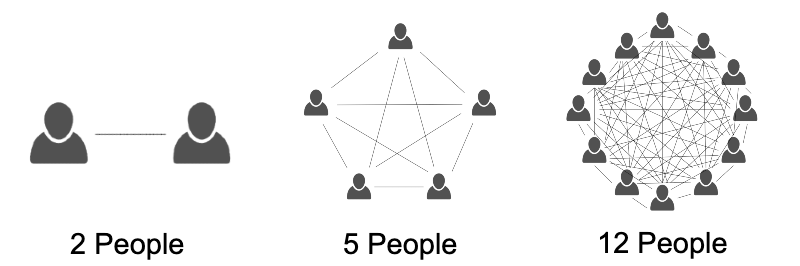
As teams grow, communication channels multiply exponentially. Two people have one channel. Five people have ten. Twelve people have sixty-six. Without a central source of truth, information gets lost in the noise.
What is a Backlog?
The backlog is a management tool comparable to established frameworks like the BCG Matrix or SWOT analysis. It functions as a collectively maintained list where team members share responsibility for updates.
Think of it like a household grocery list that multiple people maintain together. Everyone can add items, everyone can see what’s needed, and everyone understands the current state.
Core Purpose
The backlog serves to:
- Distribute knowledge across team members
- Replace fragmented communications (emails, Slack, documents)
- Improve team alignment through explicit information sharing
- Reduce poor decision-making stemming from incomplete understanding
When information lives in one person’s head or scattered across private channels, the team makes decisions with incomplete pictures. The backlog centralizes and democratizes that information.
Essential Components
Backlog Items Structure
Effective backlogs contain both needs and associated activities. Using the flat-furnishing example from my previous post, one need (“I need comfortable seating in the living room”) might have multiple potential solutions (buy a sofa, buy armchairs, buy floor cushions).
This structure allows teams to:
- Propose alternative approaches
- Understand how individual tasks fit broader objectives
- Enable non-specialists to contribute ideas
The Critical Mistake
The most significant implementation error occurs when backlogs contain only activities rather than needs.
When your backlog says “Buy a sofa” instead of “Need comfortable seating,” you’ve transformed the tool into a work-dispatch mechanism rather than a decision-support system. You’ve eliminated its strategic value.
Activities without context are just tasks. Needs with context enable better decisions.
Software Requirements
A quality backlog management tool should include:
- Configurable item types with custom fields
- Search functionality
- Complete change history
- Flexible linking between items
- Threaded discussions with cross-references
Strong UX design ensures team adoption and consistent usage. The best tool is the one your team actually uses.
The Bottom Line
The backlog isn’t just a to-do list. It’s a shared understanding of what we’re trying to achieve and why. When used well, it becomes the single source of truth for team decision-making.