Agile Series Part 3: Transparency
How to maintain and improve a project backlog as a decision-making tool through proper governance and workflow design
This series originally appeared on DevDojo in September 2021, during a career transition between roles. After scaling a fintech engineering organization from a founding team to multiple squads, I wanted to capture lessons learned about organizational alignment. The hardest question isn’t “can we build it?” but “should we build it?” This series details the management structures and Agile patterns that prevented chaos as our processes scaled alongside headcount.
A backlog can become difficult to interpret over time. As items progress through different stages, questions arise about dependencies and overall progress toward business goals. Without proper management, the backlog loses its value as a transparency tool.
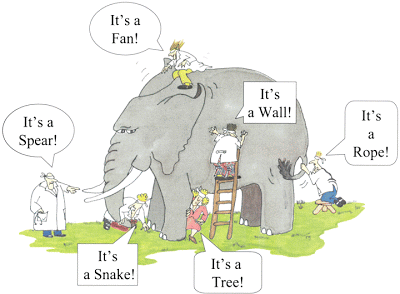
Like the blind men and the elephant, team members often perceive only fragments of the full picture. One sees a rope (the tail), another a wall (the side), another a tree (the leg). Without shared visibility, everyone optimizes for their incomplete understanding.
The Backlog Opacity Problem
You start with a clean backlog. Everything is clear, priorities are obvious, and the team knows what to work on next.
Then time passes.
Items accumulate. Some move forward, some stall, some become irrelevant but nobody removes them. Dependencies become unclear. The backlog that once provided clarity now creates confusion.
Workflows for Different Item Types
Each backlog item type will typically follow a different process.
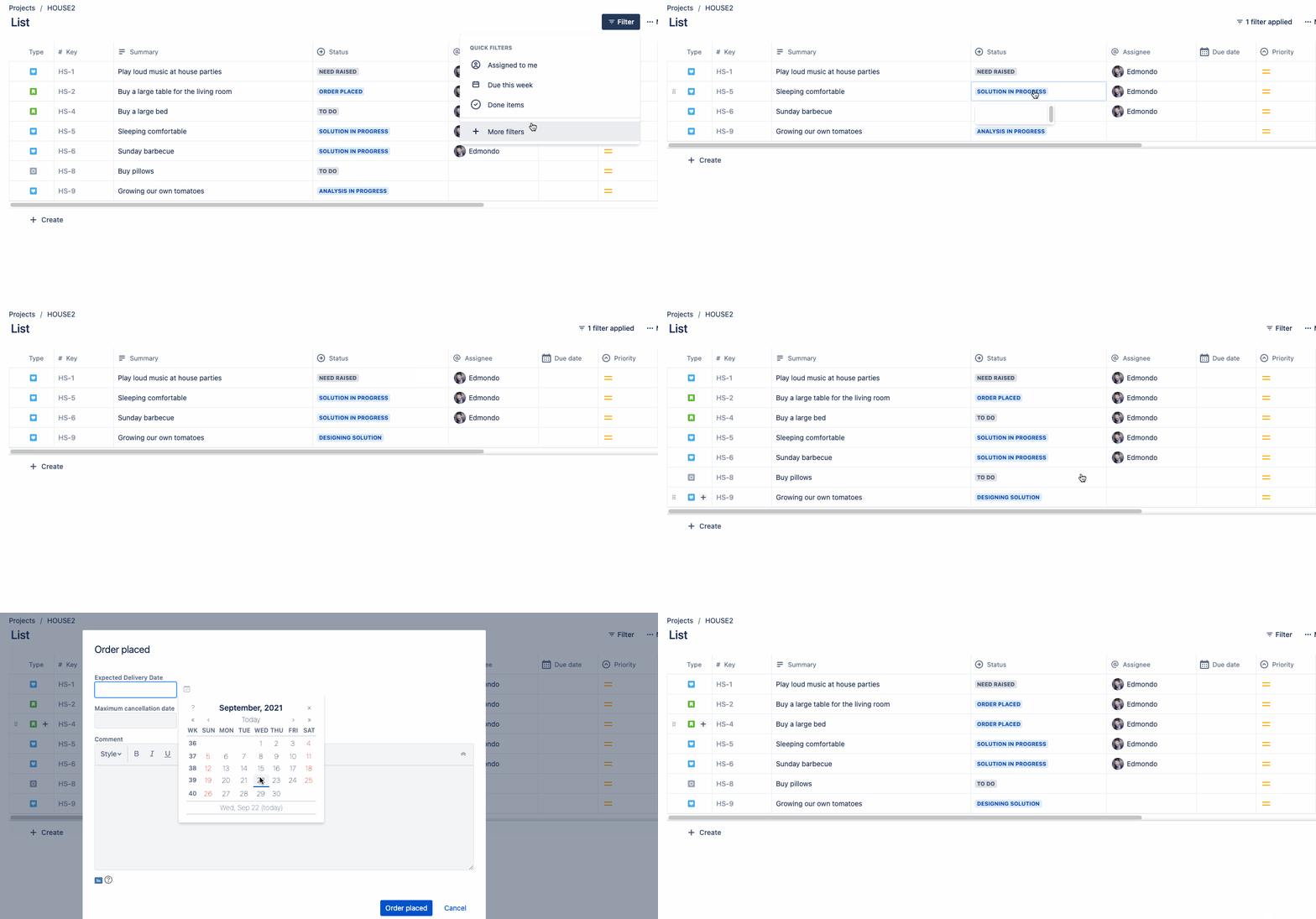
Rather than forcing all items through identical To Do/In Progress/Done statuses, create workflows suited to each category. A bug follows a different path than a feature request. A purchase approval differs from a technical investigation.
Forcing uniform workflows on diverse item types creates friction and lost information.
Flexibility Over Bureaucracy
Allow all transitions unless you have very strict process requirements (approvals, compliance, etc).
Restricting movement between statuses sounds like good governance, but in practice it traps items in wrong states. Someone marks something “In Progress” then realizes they need more information—can they move it back to “Blocked”? If your tool says no, they’ll work around it in ways that corrupt your data.
Trust your team. Let items flow naturally.
Backlog Refinement
Ongoing maintenance through backlog refinement (previously called “backlog grooming”) keeps the tool useful. This includes:
- Updating titles to reflect current understanding
- Splitting items that have grown too large
- Identifying relationships between items
- Managing evolution as items change over time
- Removing items that are no longer relevant
- Re-prioritizing based on new information
The Governance Imperative
Transparency requires active governance. Someone must oversee how the backlog changes.
Without this oversight, the backlog becomes an unusable list that no longer supports team decision-making. It becomes noise rather than signal.
This doesn’t mean micromanagement. It means someone cares enough to keep the tool useful—pruning the garden so the important things can grow.